
Trends come and go, and skincare ingredients are no exception to savvy marketing and social media hype. Skincare’s newest golden child, Bakuchiol, is being touted as nature’s anti-aging secret and an all-natural, gentle alternative to retinol, the current gold standard amongst anti-aging ingredients in skincare. While these bold claims sound too good to be true, there is some science to support Bakuchiol’s reputation as the anti-aging powerhouse skincare companies are claiming it to be. But what exactly does Bakuchiol do for the skin and is it really the same as Retinol?

What is Bakuchiol?
Bakuchiol may be new to Western skincare consumers, but it’s been used in traditional Chinese medicine and Ayurveda for centuries. Bakuchiol is an extract from the seeds of Psoralea corylifolia (nicknamed “Babchi”), a plant grown in India. Historically, Bakuchiol was used against tumors and inflammation thanks to its ability to initiate cell turnover and help initiate healing. In modern times, studies have shown that Bakuchiol initiates collagen renewal, just like Retinoids do, despite having completely different chemical structures. Bakuchiol is commonly found in serums, lotions, and creams and functions as an antioxidant that can be formulated alongside other antioxidants, humectants, emollients, and oils.
In skin care, Bakuchiol has powerful antioxidant properties that have been shown to help regenerate skin cells and promote wound healing, thereby decreasing signs of aging such as sagging skin, photoaging, and PIH (post-inflammatory hyperpigmentation). In one study, Bakuchiol was proven to increase protein synthesis and promote faster wound healing within the epidermis. Like other antioxidants, Bakuchiol is also effective at protecting against oxidative stress caused by environmental factors, notably UV exposure, and can help repair sun damage while preventing it from forming in the future.
What is Retinol?
Retinol is a type of Retinoid, a category of skincare ingredients that are derived from Vitamin A. Retinoids increase cell turnover and most importantly, stimulate collagen production. Collagen is a type of protein found within the body responsible for providing strength, elasticity, and firmness to our bones, blood vessels, tissues, and skin. Collagen production is at its highest in our youth and decreases exponentially when we age which directly contributes to the saggy, wrinkly skin and uneven skin tone we associate with old age.
Retinoids vary in strength and include Tretinoin, Tazarotene, Adapalene, and Retinol. Retinol is considered the gentlest form of Retinoids and comes in over-the-counter serums, moisturizers, and creams. Retinol can also vary in strength and can come in different percentages and forms such as Retinyl Palmitate, Retinyl Acetate, and Retinyl Linoleate.
When applied topically, Retinol can penetrate more deeply than other ingredients where it’s converted into its active form of retinoic acid. From there, it initiates cell renewal by accelerating the rate at which new skin cells like collagen are formed, leading to firmer and more youthful-looking skin at the surface.
Is Bakuchiol or Retinol better for my skin?
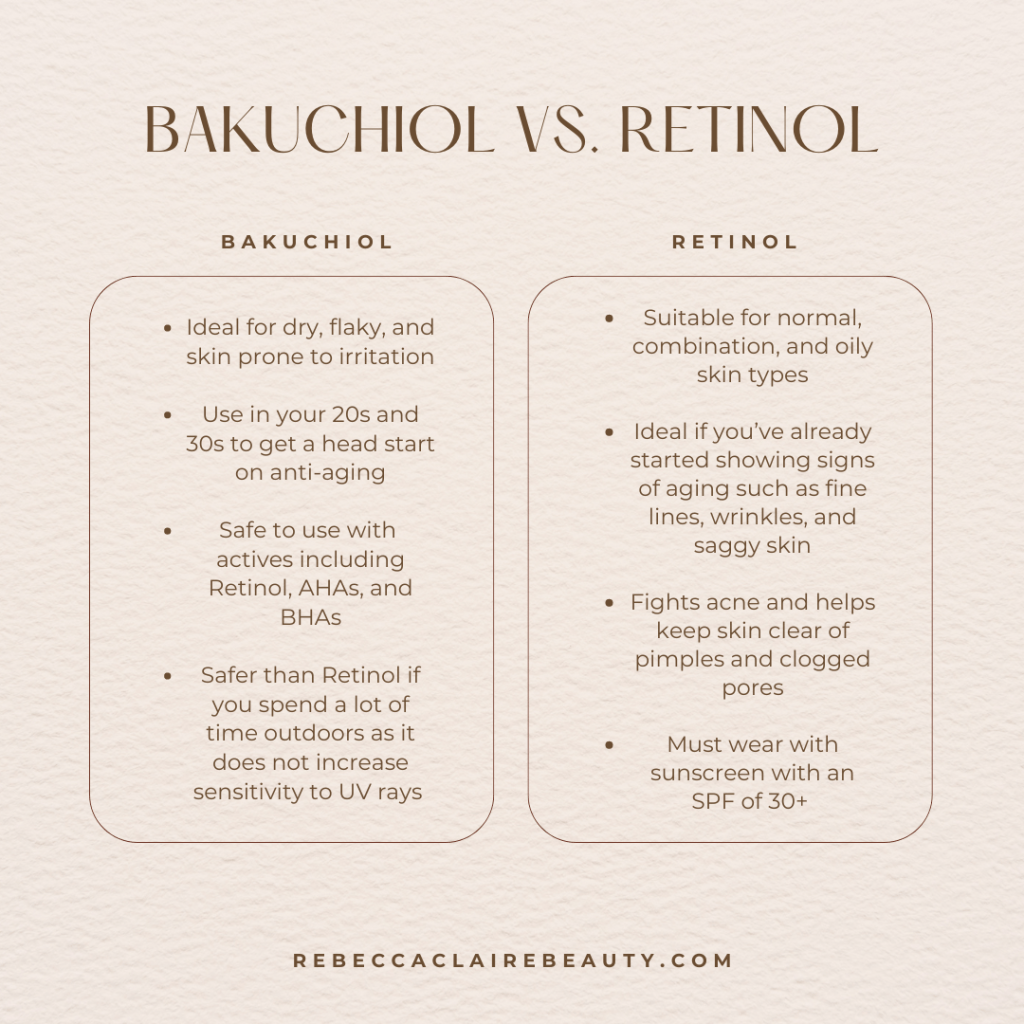
While we don’t have as many studies that observe the effects of Bakuchiol on the skin as we do for retinoids, we do have a few that have been done on a small scale. The most well-known Bakuchiol study was conducted on 44 participants over 12 weeks. This study found bakuchiol to be just as effective at fighting wrinkles and reducing uneven skin tone as retinol, but with less irritation, citing specifically “Bakuchiol and retinol both significantly decreased wrinkle surface area and hyperpigmentation, with no statistical difference between the compounds. The retinol users reported more facial skin scaling and stinging.”
While the studies on Bakuchiol are promising, they are relatively few compared to those we have on Retinoids, which have been studied since the 1980s. Retinoid studies have also been done on larger sample sizes and over longer periods. The previous Bakuchiol study, for instance, only compared Bakuchiol and Retinol over 12 weeks, which is a relatively short period of time when it comes to observing the real-time results for anti-aging effects. It’s also worth noting that this study was done with Retinol and not Tretinoin or Adapalene, which are stronger than Retinol and can offer more significant results.
Retinol is still your best, scientifically proven bet when it comes to anti-aging and acne concerns. Retinol (and Retinoids in general) have been dermatologist and doctor-recommended for decades with plenty of research on both their efficacy and safety, making them a dependable ingredient to choose if you’re serious about boosting your collagen production within the skin. Retinol has also been proven effective at fighting all types of acne including pimples, clogged pores, whiteheads, and cystic breakouts.
On the other hand, Bakuchiol is better if you have sensitive skin, dry skin, or are young enough that anti-aging benefits aren’t your main concern yet (but you still want to get a head start!). Bakuchiol is also the better alternative if you spend a lot of time outdoors as Bakuchiol doesn’t increase sensitivity to the sun like Retinoids do. Simply put, Bakuchiol is an effective anti-aging ingredient to choose when you don’t want the commitment that Retinol requires.
Can you use Bakuchiol and Retinol together?
Absolutely! The great thing about Bakuchiol is that it’s an antioxidant and plays nice with others, including Retinol, so you can safely use them together. Bakuchiol is a plant-derived antioxidant and while it shares similar results to Retinol, it doesn’t share the same chemical structure, so it has no known side effects or contraindications.
A great way to incorporate Bakuchiol and Retinol together is to use a Retinol serum with a moisturizer or cream that contains Bakuchiol. If you’re using serums, to get maximum efficacy you can use a Retinol serum on one night, and a Bakuchiol serum on another, or use your Retinol at night and Bakuchiol in the morning.
Disclaimer: The content of this website is not intended to be a substitute for professional medical advice, diagnosis or treatment. Always seek the advice of your physician with any questions regarding a medical condition.
All content is copyright © 2019-2024 Rebecca Claire Beauty. All rights reserved. Please do not use, take, copy or republish images or content without written permission. Rebecca Claire Beauty utilizes some affiliate links which may generate a small commission from clicks that result in a purchase.

 Rebecca Claire Beauty
Leave a comment