-
5 Winter Skincare Tips for All Skin Types
Winter is coming and among the myriad of things we have to prepare for, changing our skincare routine is often one of them. One way to do this is by changing our skincare products for the winter. The summer skincare products that are ideal for removing sweat and oil buildup and hydrating the skin without weighing it down are unfortunately not the best during winter when it’s crucial to maintain hydration within the skin.
While switching out your products is a great way to change your skincare routine for the winter, there are other things you can do as well that cost little to nothing–chances are you already have some of these things in your home! In this article. I’ll share practical, easy, and inexpensive tips that all skin types can incorporate into their winter skincare routine or any time of the year you’re experiencing dry and sensitive skin!

1. Watch your water temperature.
Don’t worry, I won’t tell you to take a cold shower. Instead what I suggest is either washing your face with cooler water from the sink beforehand or simply turning down the water while you’re showering when you wash your face. Hot water can overly strip the skin’s natural oils thereby weakening its natural protective barrier that keeps moisture within the skin. This leads to dryness, irritation, and inflammation, and exacerbates any existing dryness and sensitivities you may already have.
Personally, I like to turn the water down to lukewarm while I’m cleansing my face. I also wait until the end of my shower to remove my makeup and use my face cleanser as this minimizes the time my skin is exposed to water.
2. Use a humidifier while you sleep.
Even in humid climates, winter can feel dry due to many factors, so keeping enough humidity in the air indoors is crucial for a hydrated complexion. Dry air is especially common in the winter when you’re inside, as running heat can pull moisture from the skin, leading to dryness, irritation, and flakiness.
A humidifier is good for dry skin and during the winter months because it adds moisture to the air, which helps improve hydration within the skin. This is particularly helpful if you’re prone to skin conditions like eczema or psoriasis which are notorious for flaring up in the winter when keeping the skin sufficiently moisturizer is important. You don’t need anything fancy, any humidifier will do, and most will tell you the humidity percentage of your room so you can control the level. You can keep a small one by your bed at night and only run it while you sleep, as our skin does most of its regeneration at night anyway.
3. Don’t be afraid to exfoliate.
Exfoliation is a bit of a dirty word during the winter (especially if you have sensitive skin) but hear me out. By gently exfoliating dry skin you remove dead skin cells and other build-up and allow newer, healthier skin cells to emerge. Our skin is continually renewing itself and shedding dead cells, and when that process gets interrupted due to an excess of dry skin cells it can create a buildup that leaves the skin feeling tight and drier than it was to begin with. This vicious cycle can be hard to break, especially since exfoliation can also irritate sensitive skin.
The key is to exfoliate gently, either with a physical exfoliant like a scrub or a chemical exfoliant that contains something like AHAs. A gentle physical exfoliant that you most likely already have is a washcloth. I like to use one every few days with my nighttime cleanser after I’ve removed my makeup. While washcloths can be abrasive, you can control the pressure. Gently rub in circles with minimal pressure, going over each area of the face only once until you gauge how your skin responds. You can even use a baby washcloth as these come in a smoother material.
If you’d like to use a chemical exfoliant, try an AHA face cleanser with something like lactic, mandelic, or glycolic acid. Cleansers tend to be the gentlest option to choose when trying out a chemical exfoliant as they aren’t left on your skin like a serum or toner. For a more in-depth guide to exfoliating your skin during the winter, check out my Winter Skincare Guide for Exfoliation!
4. Moisturize throughout the day.
Most of us do our skincare once or twice a day and apply a moisturizer after, but there’s no hard and fast rule saying you can only moisturize after washing your face. Whether you spend your time indoors or outdoors, moisturizing throughout the day is useful when you’re inside all day and the heat is running, or you’re exposed to wind and cold.
This gets tricky if you’re wearing makeup or sunscreen, which is why I recommend keeping a hydration spray or spray moisturizer for your face on hand during the winter. These lightweight spray lotions have the consistency of a serum with humectants and emollients that help protect the skin much like a traditional moisturizer does. Spray moisturizers are also the best way to moisturize over makeup and sunscreen as they don’t need to be rubbed into the skin.
If you prefer, you can always use a regular moisturizer or lotion throughout the day. I like to apply my lotion after lunchtime when I’m working around the house and not wearing anything on my face. If I’m wearing sunscreen I’ll simply apply another coat afterward and my skin feels as good as new.
5. Don’t be afraid to use an occlusive.
Occlusive may not be a skincare term you’re familiar with, but chances are you’ve already used one. Simply put, an occlusive is a moisturizing ingredient that creates a barrier on the skin to prevent water loss and help keep skin hydrated. The most well-known occlusive is petroleum jelly, which you’ve probably seen sold as Vaseline or Aquaphor. Other skincare ingredients such as oils and butters can be occlusive. Heavier oils such as castor and mineral are thick enough to help create a barrier over the skin. Shea butter is another occlusive that is protective and rich in nutrients that help smooth the skin.
The downside to using an occlusive such as petroleum jelly is that while it seals moisture on the surface of the skin, it seals in everything else, too. This means if you’re prone to clogged pores and buildup (such as the bacteria that leads to acne) you’ll trap that in and you likely won’t see an improvement in skin texture and breakouts.
Luckily, it’s pretty easy to tell if an occlusive skincare ingredient will work for your skin type. Apply your occlusive of choice at night and at the end of your skincare routine. Either you’ll wake up with skin that feels baby soft or your skin will look congested and dull, either of which will give you your answer on whether or not occlusive ingredients are good for your skin!
Occlusive ingredients work anywhere you have dry skin, not just the face! You can apply occlusive skincare ingredients to your hands, cuticles, feet, and any other dry and rough areas of the body.
Disclaimer: The content of this website is not intended to be a substitute for professional medical advice, diagnosis or treatment. Always seek the advice of your physician with any questions regarding a medical condition.
All content is copyright © 2019-2024 Rebecca Claire Beauty. All rights reserved. Please do not use, take, copy or republish images or content without written permission. Rebecca Claire Beauty utilizes some affiliate links which may generate a small commission from clicks that result in a purchase.
-
Is Bakuchiol as effective as Retinol? What the science says.
Trends come and go, and skincare ingredients are no exception to savvy marketing and social media hype. Skincare’s newest golden child, Bakuchiol, is being touted as nature’s anti-aging secret and an all-natural, gentle alternative to retinol, the current gold standard amongst anti-aging ingredients in skincare. While these bold claims sound too good to be true, there is some science to support Bakuchiol’s reputation as the anti-aging powerhouse skincare companies are claiming it to be. But what exactly does Bakuchiol do for the skin and is it really the same as Retinol?
What is Bakuchiol?
Bakuchiol may be new to Western skincare consumers, but it’s been used in traditional Chinese medicine and Ayurveda for centuries. Bakuchiol is an extract from the seeds of Psoralea corylifolia (nicknamed “Babchi”), a plant grown in India. Historically, Bakuchiol was used against tumors and inflammation thanks to its ability to initiate cell turnover and help initiate healing. In modern times, studies have shown that Bakuchiol initiates collagen renewal, just like Retinoids do, despite having completely different chemical structures. Bakuchiol is commonly found in serums, lotions, and creams and functions as an antioxidant that can be formulated alongside other antioxidants, humectants, emollients, and oils.
In skin care, Bakuchiol has powerful antioxidant properties that have been shown to help regenerate skin cells and promote wound healing, thereby decreasing signs of aging such as sagging skin, photoaging, and PIH (post-inflammatory hyperpigmentation). In one study, Bakuchiol was proven to increase protein synthesis and promote faster wound healing within the epidermis. Like other antioxidants, Bakuchiol is also effective at protecting against oxidative stress caused by environmental factors, notably UV exposure, and can help repair sun damage while preventing it from forming in the future.
What is Retinol?
Retinol is a type of Retinoid, a category of skincare ingredients that are derived from Vitamin A. Retinoids increase cell turnover and most importantly, stimulate collagen production. Collagen is a type of protein found within the body responsible for providing strength, elasticity, and firmness to our bones, blood vessels, tissues, and skin. Collagen production is at its highest in our youth and decreases exponentially when we age which directly contributes to the saggy, wrinkly skin and uneven skin tone we associate with old age.
Retinoids vary in strength and include Tretinoin, Tazarotene, Adapalene, and Retinol. Retinol is considered the gentlest form of Retinoids and comes in over-the-counter serums, moisturizers, and creams. Retinol can also vary in strength and can come in different percentages and forms such as Retinyl Palmitate, Retinyl Acetate, and Retinyl Linoleate.
When applied topically, Retinol can penetrate more deeply than other ingredients where it’s converted into its active form of retinoic acid. From there, it initiates cell renewal by accelerating the rate at which new skin cells like collagen are formed, leading to firmer and more youthful-looking skin at the surface.
Is Bakuchiol or Retinol better for my skin?
While we don’t have as many studies that observe the effects of Bakuchiol on the skin as we do for retinoids, we do have a few that have been done on a small scale. The most well-known Bakuchiol study was conducted on 44 participants over 12 weeks. This study found bakuchiol to be just as effective at fighting wrinkles and reducing uneven skin tone as retinol, but with less irritation, citing specifically “Bakuchiol and retinol both significantly decreased wrinkle surface area and hyperpigmentation, with no statistical difference between the compounds. The retinol users reported more facial skin scaling and stinging.”
While the studies on Bakuchiol are promising, they are relatively few compared to those we have on Retinoids, which have been studied since the 1980s. Retinoid studies have also been done on larger sample sizes and over longer periods. The previous Bakuchiol study, for instance, only compared Bakuchiol and Retinol over 12 weeks, which is a relatively short period of time when it comes to observing the real-time results for anti-aging effects. It’s also worth noting that this study was done with Retinol and not Tretinoin or Adapalene, which are stronger than Retinol and can offer more significant results.
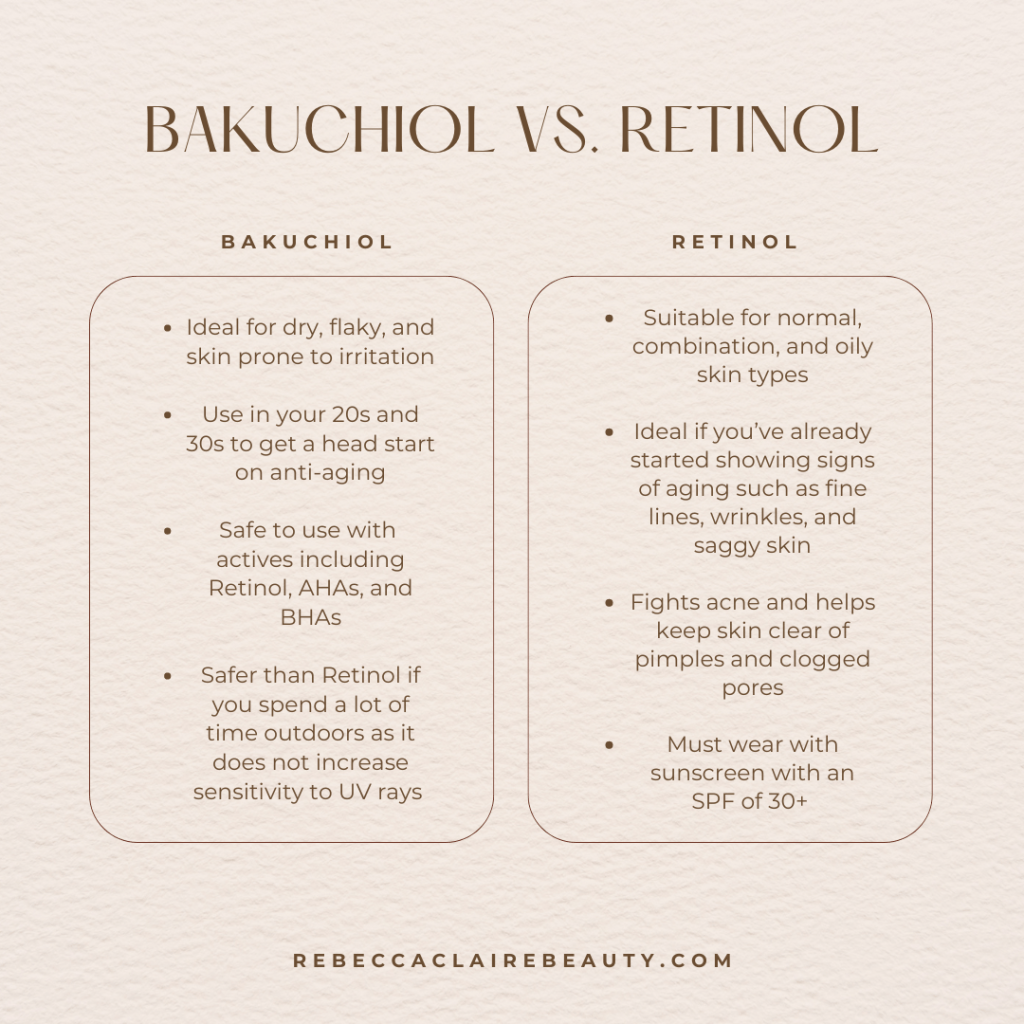
Retinol is still your best, scientifically proven bet when it comes to anti-aging and acne concerns. Retinol (and Retinoids in general) have been dermatologist and doctor-recommended for decades with plenty of research on both their efficacy and safety, making them a dependable ingredient to choose if you’re serious about boosting your collagen production within the skin. Retinol has also been proven effective at fighting all types of acne including pimples, clogged pores, whiteheads, and cystic breakouts.
On the other hand, Bakuchiol is better if you have sensitive skin, dry skin, or are young enough that anti-aging benefits aren’t your main concern yet (but you still want to get a head start!). Bakuchiol is also the better alternative if you spend a lot of time outdoors as Bakuchiol doesn’t increase sensitivity to the sun like Retinoids do. Simply put, Bakuchiol is an effective anti-aging ingredient to choose when you don’t want the commitment that Retinol requires.
Can you use Bakuchiol and Retinol together?
Absolutely! The great thing about Bakuchiol is that it’s an antioxidant and plays nice with others, including Retinol, so you can safely use them together. Bakuchiol is a plant-derived antioxidant and while it shares similar results to Retinol, it doesn’t share the same chemical structure, so it has no known side effects or contraindications.
A great way to incorporate Bakuchiol and Retinol together is to use a Retinol serum with a moisturizer or cream that contains Bakuchiol. If you’re using serums, to get maximum efficacy you can use a Retinol serum on one night, and a Bakuchiol serum on another, or use your Retinol at night and Bakuchiol in the morning.
Disclaimer: The content of this website is not intended to be a substitute for professional medical advice, diagnosis or treatment. Always seek the advice of your physician with any questions regarding a medical condition.
All content is copyright © 2019-2024 Rebecca Claire Beauty. All rights reserved. Please do not use, take, copy or republish images or content without written permission. Rebecca Claire Beauty utilizes some affiliate links which may generate a small commission from clicks that result in a purchase.
-
An Esthetician’s Top 5 Favorite Korean Sunscreens

I have a secret. I didn’t always wear sunscreen. In fact, it probably wasn’t until my mid-20s after I graduated from cosmetology school that I made it a daily habit. This seems to be the consensus among my fellow millennials. While we knew sun damage was bad we didn’t seem to understand just how bad. Sun damage was this vague concern that felt far enough off into the future that I would worry about it later. Fast forward to a decade later and a melanoma scare and I wear it every day, no matter the season, rain or shine.
I think I speak for most when I say that the main reason my generation never cared to make sun protection a daily habit was due to the mediocre options we have here in America. Between the heavy, greasy feeling they leave on the skin, clogged pores and pimples, and the thick white cast that leaves even the palest of us looking like a ghost, American sunscreens just don’t seem to cut it.
These days, mostly thanks to social media and exposure to products from all over the world, Asian sunscreens have given many of us the enthusiasm we need to wear sunscreen every day. Known for their sensitive-skin friendly and lightweight formulas, Asian sunscreens such as those from Korea and Japan, use formulas that focus on hydration, soothing inflammation, and protection against future skin damage. In addition, they also have more comfortable formulas that are lightweight, non-greasy, and leave little to no white cast.
The secret to Korean Sunscreens is their UV filters which are more advanced and up-to-date than those in the states. Asian sunscreens such as those from Korea use newer, more photostable UVA and UVB filters like Tinosorb S (bemotrizinol), Tinosorb M (bisoctrizole), Uvinul A Plus (diethylamino hydroxybenzoyl hexyl benzoate), and Uvinul T 150 (octyl triazone). These filters provide broad-spectrum protection and better stability that allow for a more lightweight and non-greasy formula without sacrificing sun protection.
Korean sunscreens are often formulated with protective antioxidant plant extracts popular in Asia such as Green Tea and Centella known to help prevent photoaging, soothe inflammation, and improve moisture levels within the skin. They also use more common ingredients known in America such as Niacinamide to fight acne without drying out the skin and Aloe Vera leaf hydrate without clogging pores. Korean sunscreens also wear well under makeup and can even be used in place of makeup primers.
As an esthetician whose job is to recommend skincare products to others, I like to try the products that I preach first, and I’ve definitely tried my share of Korean sunscreens over the past few years. While some are more suited for my skin than others, I’ve yet to try one I can honestly say I didn’t like. Below, I’ll share my top 5 favorite Korean sunscreens and who they’re best suited for.

Skin1004 Hyau Cica Sun Serum SPF50+ PA+++
All Skin Types Including Dry and Sensitive, Fragrance-free
To start our list of best Korean sunscreens for 2024 we have the Hya Cica Sun Serum from Skin1004. With a fragrance-free and hypoallergenic formula that’s full of botanical extracts such as Green tea and Centella, it’s the quintessential Korean sunscreen. For those with normal to oily skin, its lightweight, hydrating formula makes it suitable to use as both your moisturizer and sunscreen. For those who lean towards being dry and sensitive, it seamlessly layers on top of your favorite moisturizer without feeling too heavy or greasy throughout the day and makes a good makeup primer for dry skin.
Isntree Watery Sun Gel SPF50+ PA+++
Normal, Acne-prone, and Oily Skin, Fragrance-free
If your skin leans towards being oily, then I recommend Isntree Watery Sun Gel. This Korean sunscreen is particularly unique in that it has a lightweight gel consistency that hydrates and binds moisture to the skin making it ideal for those who are prone to acne and clogged pores. The Isntree Watery Sun Gel Korean sunscreen is fragrance-free and contains Hyaluronic Acid and Ceramides to bind and replenish moisture to the skin, and Astaxanthin, a popular Korean skincare ingredient that has been shown to reduce inflammation and redness caused by UV exposure. With no white cast thanks to its gel texture, it’s one of the best Korean sunscreens for all skin tones.
COSRX Aloe Soothing Sun Cream SPF50+ PA+++
Dry to Normal Skin, Lightly Fragranced
For those with dry to normal skin who want a moisturizer and sunscreen in one, the COSRX Aloe Soothing Sun Cream protects against UV exposure while hydrating and soothing the skin. Its ingredients include Aloe Leaf extract and Glycerin that bind moisture to the skin long after it’s been applied without feeling heavy or leaving a white cast. With a light fragrance that disappears after it’s been absorbed, the COSRX Aloe Soothing Sun Cream is a good Korean sunscreen to start with for those new to Asian sunscreens. It’s natural and slightly dewy finish also makes for a great primer under makeup.
Beauty of Joseon – Relief Sun SPF 50+ PA++++
Sensitive, Dry, Acne-prone, and Normal Skin, Fragrance-free
Sensitive skin prone to acne and redness is probably the trickiest skin type and can be difficult to treat. If this sounds like you, I recommend the fragrance-free Beauty of Joseon Relief Sun SPF 50+ PA++++. While it’s a great Korean sunscreen for all skin types, it’s especially suited for those with skin sensitivities such as flakiness, dryness, and irritation that’s prone to breakouts. Its star ingredient is an infusion of 30% Rice extract that’s rich in natural probiotics to help soothe acne-prone skin while keeping it hydrated. This lightweight Korean sunscreen is formulated with EWG-certified ingredients and has a non-greasy texture that leaves no white cast.
MISSHA – All-Around Safe Block Essence Sun SPF45 PA+++
Normal, Oily, and Acne-prone Skin, Lightly Fragranced
Last on our list is the MISSHA – All-Around Safe Block Essence Sun SPF45 PA+++, another good Korean sunscreen to start with for those new to sun protection. Rich in natural antioxidants derived from plants, it contains Apricot, Lotus, Chrysanthemum, and Camellia flower extracts that nourish and protect against cellular damage from UV exposure. It’s also formulated with Thanaka extract that has a unique cooling effect when applied. With a natural, glowy finish, MISSHA Safe Block Essence Korean Sunscreen can be used as a makeup primer.Disclaimer: The content of this website is not intended to be a substitute for professional medical advice, diagnosis or treatment. Always seek the advice of your physician with any questions regarding a medical condition.
All content is copyright © 2019-2024 Rebecca Claire Beauty. All rights reserved. Please do not use, take, copy or republish images or content without written permission. Rebecca Claire Beauty utilizes some affiliate links which may generate a small commission from clicks that result in a purchase.
-
Skincare Products Mom and Baby Can Share
Having a baby is kind of like getting a new roommate. They have their own room, their own laundry, make plenty of noise, and you have to share your bathroom. Above all else, adding another person to your household means less room for your own things. So, what better way to reduce clutter than sharing products with your baby?
Most moms-to-be buy plenty of skincare products specifically marketed for babies but there are plenty of skincare products on the market for adults that work for babies, too (and in some cases are even the same formula!). Below I’m sharing my favorite skincare finds that work for both mom and baby so you can save money and space.
Eucerin 2 in 1 Baby Wash and Shampoo
As far as a sensitive skin and baby-friendly skincare product, Eucerin 2 in 1 baby wash and shampoo is the quintessential baby hair and body wash. It’s fragrance-free, hypoallergenic, and suds up nicely, giving you the feeling you’re really getting clean without leaving the skin feeling stripped and dry. It’s also tear-free and I can personally confirm it’s safe for the baby’s eye area.
Eucerin 2 in 1 wash for baby doubles as a shampoo and body wash for mom, too. I started using this as a body wash shortly after I bought it because I like to keep my own skincare products fragrance-free since my baby frequently comes into contact with my skin. Lastly, it’s a great facial cleanser for dry and sensitive skin types, especially for breastfeeding moms who are prone to dry skin. I like to use it after removing any sunscreen and makeup with an oil-based cleanser as it leaves my skin thoroughly cleansed without stripping away too much moisture.
Aquaphor
A skincare classic, Aquaphor is an excellent skin protector that protects against inflammation, irritation, and moisture loss. It can also be used in place of a moisturizer for the face and body during the winter for extra dry and flaky skin. For babies, Aquaphor has several uses. It can be used as a diaper rash cream and can be used both to help heal active rashes and prevent them in the future. It’s also great to apply over any tiny scratches from your baby’s fingernails and flaky patches on the face where many babies are prone to dryness.
For moms, Aquaphor has just as many uses as it does for babies. It works as a lip balm, face and body moisturizer, and an occlusive barrier for cuts, scratches, itchiness, and just about any other skin irritation you can think of.

Cerave Moisturizing Cream
A cult favorite among skincare enthusiasts, Cerave Moisturizing Cream (famously dubbed “Cerave in the tub”) in the tub works wonders for babies, too. This rich moisturizing cream is known for its deep hydration benefits and ability to restore moisture and protect the skin barrier while also being fragrance-free and safe for sensitive skin. It’s thick, emollient, and leaves skin feeling smooth and hydrated long after it’s been applied, making it ideal for dry skin, especially during winter.
For babies, it functions as a moisturizer and skin protectant in one and can be applied anywhere. It’s also safe for baby eczema and cradle cap and can help protect the area to which it’s applied by soothing inflammation and itchiness to help keep babies from scratching themselves.
Vanicream Moisturizing Skin Cream
One of my personal favorite skincare products that I often recommend as an esthetician is the Vanicream Moisturizing Skin Cream. This has been my favorite all-purpose moisturizer for a few years that I use on both my face and body. With a similar formula to Cerave’s Moisturizing Cream, I find that Vanicream has a slightly lighter feel to it and feels less heavy and greasy, making it ideal for normal to oily skin.
Its formula also doubles as a sensitive skin-friendly and fragrance-free lotion for babies. I’ve used it as an all-over body lotion for my baby and even all over the scalp and directly over the hair after a bath to help with cradle cap and seal hydration into the skin.
Coconut Oil
For a completely natural skincare product, 100% virgin coconut oil can’t be beat for mom and baby. Like Aquaphor, coconut oil is a multi-benefit product that can be used for just about everything skin and hair-related. Coconut oil can usually be found in the cooking aisle at your local store and is solid at room temperature. It has a thinner consistency than Aquaphor and a little goes a long way.
Coconut oil can be a bit divisive, as people who have tried it either love or hate it. For some, coconut oil can be comedogenic and cause buildup leading to small pimples and clogged pores. To ensure that you and your baby aren’t sensitive to coconut oil, do a small patch test on the skin behind the ear or underneath the chin to ensure you aren’t sensitive to it.
Disclaimer: The content of this website is not intended to be a substitute for professional medical advice, diagnosis or treatment. Always seek the advice of your physician with any questions regarding a medical condition.
All content is copyright © 2019-2024 Rebecca Claire Beauty. All rights reserved. Please do not use, take, copy or republish images or content without written permission. Rebecca Claire Beauty utilizes some affiliate links which may generate a small commission from clicks that result in a purchase.
-
5 Easy Ways to Change Your Skincare for Summer
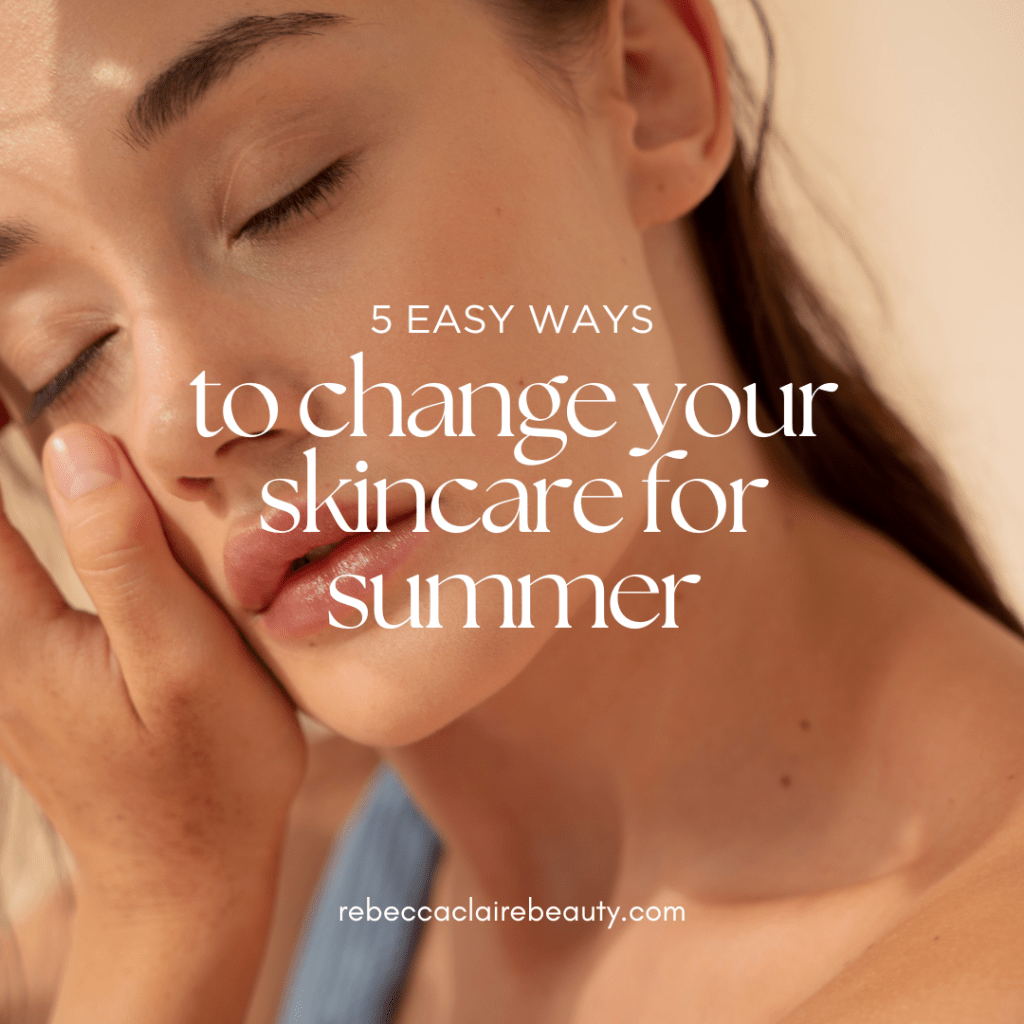
Transitioning your skincare routine to stand against the challenges of summer is crucial for maintaining a healthy, radiant complexion. Below I’ll share 5 quick and easy tips to make the most of the summer sun that you can easily incorporate into your skincare routine during the warmer months. From selecting the right sunscreen to hydrating your skin effectively, here’s how you can make the most of summer without compromising your skin’s health.
1. Switch up Your Face Cleanser
The cooler months are known for drying out the skin and causing redness and irritation leading many of us to use a gentle cleanser. On the other hand, our skin can usually handle face cleansers with a stronger formula during the summer when it’s hot and humid. We’re also more likely to accumulate sweat, oil, and other buildup that needs to be properly washed off at the end of the day to prevent clogged pores that can lead to dull skin and uneven skin texture.
Whereas you may opt for a more gentle gel or cream cleanser during the winter, the summer is the perfect time to try face washes such as foaming cleansers and acne cleansers. These tend to cleanse more deeply to help control excess oil and sweat, keeping your skin clear and refreshed during the hotter weather. If you have sensitive skin and aren’t too keen on giving up your usual face wash for the options listed above, you can always double cleanse. Start with an oil-based balm or cleansing oil to remove any makeup and sunscreen and then follow with your regular cleanser to remove any excess residue.
2. Use a Lightweight Moisturizer
Many of us opt for rich creams and heavy moisturizers in the winter when we need an extra boost of hydration but during the summer you may need to switch to an oil-free or lightweight moisturizer. If you have normal, combination, or oily skin, you may notice your skin feels heavy and greasy throughout the day during the summer due to the increased heat and humidity.
Lightweight moisturizers are usually gel-based or oil-free and great for the summer months. These formulations provide hydration and moisture without weighing the skin down. They absorb quickly and layer well under sunscreen even in the heat and humidity. Additionally, many lightweight moisturizers bind hydration to the skin without the use of oils by using easily tolerated ingredients like hyaluronic acid or aloe vera, which are good for even the most sensitive of skin types.

3. Buff up Your SPF
By now, most of us understand the importance of wearing sunscreen. Although it’s essential to use sunscreen year-round, the longer days and increased outdoor activities during the summer months result in more sun exposure making it crucial to wear sunscreen with adequate SPF protection. Depending on your usual sunscreen, you might want to switch to a different one with a higher SPF.
The American Academy of Dermatology recommends using a broad-spectrum sunscreen (meaning it protects against both UVA and UVB rays) with an SPF of at least 30. Most importantly, be sure to use enough to cover the area you’re applying to. A good rule of thumb for the face and neck is to apply two finger-lengths worth of sunscreen. Lastly, don’t forget to reapply your sunscreen for every 2 hours you’re exposed to the sun.
4. Cut back on Retinol and AHAs
While retinoids and AHAs are known for fighting signs of aging and keeping breakouts at bay, they don’t come without risks, especially during the summer. Retinoids such as tretinoin and retinol and AHAs like glycolic, lactic, and mandelic acid work by chemically exfoliating the top layer of the skin, and in doing so, leave it more sensitive to UV rays. This can lead to damage such as hyperpigmentation and sun spots if you aren’t sufficiently protecting your skin, undoing all the hard work these ingredients do in the first place.
If you’re using adequate sunscreen and reapplying often when you’re outside, then you can probably carry on with your regular skincare routine. However, if you have any skin sensitivities or notice your skin feels more sensitive, you may want to try reducing the frequency or changing the time of day you use your retinol and AHA skincare products.
If you apply a retinoid or AHA serum every other night, you may want to cut back to every third day. You can also quit using these products during the day. If you use any products containing these ingredients in your morning skincare routine, you can switch to using them at night. Remember, less is more during the summer when it comes to using strong ingredients like retinol and AHAs!
5. Add Vitamin C
A popular ingredient found in serums, moisturizers, and even cleansers, Vitamin C is a multi-benefit antioxidant that is scientifically proven for its ability to fight against damage from UV exposure and other environmental factors. Applying Vitamin C to the skin wards against oxidative stress in skin cells that can result from sun exposure, and if left unchecked, can lead to signs of aging, uneven skin tone, and dull, textured skin tone.
Vitamin C is a great addition to your skincare routine anytime during the year but becomes especially important when you’re outside in the sun. In fact, studies have shown that vitamin C not only helps protect against the damage sun exposure causes in the first place, but it can help boost the efficacy of your sunscreen, specifically against UVB rays when combined with a broad spectrum SPF!
Disclaimer: The content of this website is not intended to be a substitute for professional medical advice, diagnosis or treatment. Always seek the advice of your physician with any questions regarding a medical condition.
All content is copyright © 2019-202 Rebecca Claire Beauty. All rights reserved. Please do not use, take, copy or republish images or content without written permission. Rebecca Claire Beauty utilizes some affiliate links which may generate a small commission from clicks that result in a purchase.
-
An Esthetician’s Guide to a Pregnancy Safe Skincare Routine for Acne
Acne-fighting ingredients are in all types of skincare products. Between acne cleansers, toners, spot treatments, and serums, there’s no shortage of skincare products being advertised to give you clear skin. It’s especially overwhelming when you’re pregnant and have to worry about whether or not an ingredient or skincare product is safe for pregnancy. To make matters worse, even if you have an idea of which ingredient you want to use, you then have to choose whether you want a face wash, toner, or serum. So, how do you decide which is right for you?
In this article, I’ve made it easy for moms-to-be dealing with breakouts by sharing my go-to acne routines during pregnancy. I’ll explain what to avoid, what to use and how often, and what personally worked for me during my pregnancy.
Can I use the same acne products during pregnancy that I was using before I got pregnant?
Depending on the severity and type of acne you’re experiencing while pregnant, you may not have to overhaul your whole skincare routine. You may even already have some acne products that are pregnancy-safe and perfectly fine to use throughout both your pregnancy and breastfeeding journey. With that said, the majority of acne products on the market contain ingredients that aren’t pregnancy safe, namely salicylic acid and benzoyl peroxide (in high concentrations), and retinoids.
With salicylic acid and benzoyl peroxide, the poison makes the dose. Since it can be hard to determine the exact percentage a skincare product contains, you’ll often see doctors discouraging their use entirely just to be safe. Generally speaking, however, skincare products containing 2% or less salicylic acid and 5% or less benzoyl peroxide are fine to use during pregnancy. These lower concentrations can usually be found in acne cleansers and toners whereas serums and spot treatments often contain more. If you are concerned about a specific skincare product and whether or not it’s pregnancy-safe, always consult with your doctor.
Stronger ingredients like retinoids must be avoided during pregnancy entirely and you should stop use immediately when you find out you’re pregnant. This can be difficult since they are often used for acne and can be purchased both over the counter and prescribed by a doctor. Even small percentages should be avoided as retinoids have been shown to cause birth defects.
Common skincare products containing retinoids that you may be using to treat acne include retinol serums, creams and moisturizers, and Differin (also known as adapalene) gel. For prescriptions, Retin-A, adapalene, and tazarotene are topical skincare products containing retinoids to avoid using during pregnancy. Prescription oral retinoids like Accutane should also be immediately stopped and avoided during pregnancy and breastfeeding.
Acne Skincare Routines for Pregnancy

If You’re Pregnant and Have Mild Acne
I often heard before getting pregnant that your skin either glows during pregnancy or you end up an oily greaseball covered in breakouts. I was terrified that I would be the latter given I’ve had acne-prone skin all my life. Surprisingly, my skin was quite clear throughout my pregnancy.
Before you call me lucky, it was a double-edged sword. I seemed to produce absolutely no oil anywhere, even my scalp, and had dry, flaky skin everywhere on my body. No matter what I wore, clothes irritated me and even my bed sheets made me itch. I would slather oil and body cream in thick layers every night only to be flaky again as soon as I woke up. That being said, it was nice not to have to worry about the painful, cystic breakouts I had been used to before pregnancy.
If you’re like me and have mild acne concerns throughout your pregnancy, then I suggest simply switching out your normal face wash to an acne cleanser. Acne cleansers tend to have the lowest concentration of ingredients and only stay on the skin for a handful of seconds which makes them a great skincare product to use to stay ahead of breakouts and prevent acne from forming in the first place. I always suggest starting slow with a new acne product, even if it’s a cleanser, and using it 2-3 nights a week while your skin gets acclimated.
One of the biggest mistakes I see clients make when they have acne is using too many ingredients at too high of a concentration at once. If you aren’t actively having breakouts, don’t go overboard with a serum or treatment as these can dry your skin out and possibly strip your skin barrier (especially if you’re already producing less oil like I was).
My favorite acne cleansers and face washes for pregnancy contain AHAs (alpha hydroxy acids) such as glycolic, acid, lactic, PHAs (polyhydroxy acids), Benzoyl Peroxide (5% or less concentration), and sulfur. These are considered the gentlest class of chemical exfoliants as they are water-soluble, meaning they only work on the skin’s surface where they help remove dead skin cells and buildup (including the bacteria that causes acne) and help increase skin cell turnover. Another benefit of AHAs and PHAs is that they have been shown to have moisturizing properties and help increase our own skin’s natural moisturizing factors which is important during pregnancy if you’re like myself and have dry skin.
One of the best acne cleansers for pregnancy that’s ideal for dry skin is the Neutrogena Skin Balancing Milky Cleanser. It has a milky, cream-like formula that’s great to use in the mornings or if you have irritated skin. This is a cleanser I’ve often used even pre and post pregnancy when my skin is feeling dehydrated. Next up is the Differin Acne Face Wash with 5% Benzoyl Peroxide. I consider this the perfect cleanser for acne to start with if you don’t know your skin type–it’s not overly drying yet it thoroughly washes the face. Lastly, if you have excessively oily skin and get breakouts, I recommend the Honest Beauty Get Clarity Cream to Foam Acne Cleanser which contains both sulfur and AHAs to absorb excess oil while getting rid of dead skin cells and other buildup.
Remember to always start slow and work your way up when using a new acne cleanser. Follow up with a good moisturizer for your skin type and you’re done! If you’re oily, opt for an oil-free or gel moisturizer. If you’re dry, choose a thicker cream. In the mornings, be sure to wear sunscreen if you’re going outside. It seems surprisingly simple but if you’re not dealing with a lot of breakouts, a little prevention with an acne cleanser is all you need.
If You’re Pregnant and Have Moderate to Severe Acne
Whether you’re excessively oily, breaking out more often, or don’t notice enough changes to your skin after using an acne cleanser, then you may want to add another step to your acne skincare routine during pregnancy. Here’s where it gets tricky for most people, but I’ll break it down in steps for you and explain your options: you can add a toner or serum (or both) and spot treat your breakouts.
Toners have come a long way, and these days acne toners specifically come in a wide variety of formulas made to be as hydrating as possible while still fighting breakouts. My favorite pregnancy-safe toners for acne are those that contain AHAs, PHAs, and niacinamide. Toners, like cleansers, have a lower percentage of active ingredients compared to those of serums, but unlike cleansers, they are left on the face and can be mixed with other ingredients such as humectants and antioxidants for even more skin benefits.
My personal favorite toner that I used even pre-pregnancy is the COSRX AHA 7 Whitehead Power Liquid. This toner is especially great if you’re prone to irritation as it has apple water that soothes and hydrates the skin. For those who need and can tolerate something stronger, my second favorite toner that is also pregnancy-safe for acne is the Wishtrend Mandelic Acid 5% Skin Prep Water. This toner is quite effective but also strong, so I definitely recommend only using it 2-3 times a week until you know your skin can tolerate it. If you have particularly oily skin and/or enlarged pores, I suggest the Paula’s Choice Skin Balancing Pore-Reducing Toner to treat your acne during pregnancy.
Next up for treating acne during pregnancy are serums. Serums are usually where you get the most concentration of ingredients. Like toners, the best pregnancy-safe acne serums will have ingredients like AHAs, PHAs, niacinamide, and one of my personal favorite ingredients, azelaic acid. There are so many serums on the market, most of which contain a mix of these ingredients, so finding the right serum for your skin, especially during pregnancy can be overwhelming. With this in mind, if you don’t know which acne serum to use when you’re pregnant, I recommend choosing a serum formulated with another pregnancy-safe ingredient that’s different from your cleanser and/or toner.
For a pregnancy-safe serum that contains AHAs, I recommend the CeraVe Skin Renewing Nightly Exfoliating Treatment. This is also a good skincare product if you have dry or sensitive skin. If you can tolerate a stronger AHA serum, especially if you’re excessively oily and have a lot of whiteheads and clogged pores, I recommend the Alpha Skin Care Renewal Serum with 14% AHA. If you have hyperpigmentation or pregnancy melasma, then I recommend something with azelaic acid or niacinamide like the Naturium Azelaic Topical Acid 10%.
If you’re dealing with the occasional breakout, especially pustules or pimples with a head on them, then you may be able to treat your pregnancy acne by simply spot treating these breakouts as they occur. I suggest spot treating with a sulfur-based acne product like the De La Cruz Sulfur Treatment which can be left on for 10 minutes before being washed off. Pimple patches are also perfectly safe for pregnancy. If your breakout is really stubborn, you can use the sulfur treatment and wear a pimple patch afterward.
As with an acne cleanser, always start slowly incorporating a toner, serum, or spot treatment (especially ones with high percentages!) to make sure you don’t cause any skin sensitivities and your skin can acclimate. By starting slowly and seeing how your skin reacts you can fine-tune how often and when you use your acne products during pregnancy. You may even find you don’t need to use them every day, or you may find you prefer using your acne serum on the days you don’t use an acne cleanser.
If You’re Pregnant and Have Severe Acne and Cystic Breakouts
Many women unfortunately find themselves dealing with painful, large breakouts that don’t respond to over-the-counter options. This is completely normal during pregnancy and often corrects itself a few months postpartum. In the meantime, you don’t have to suffer! Your OBGYN is able to treat you with something or offer suggestions.
This doesn’t mean you have to give up your current acne products if you’re using an acne cleanser, toner, or serum like those discussed above, but you may need something stronger to help long-term. Commonly prescribed pregnancy-safe acne treatments that you can discuss with your doctor are a 15% azelaic acid gel, also known as Finacea, a clindamycin and benzoyl peroxide gel, and erythromycin.
It’s important to see your OBGYN or dermatologist as only they can determine which of these acne prescriptions is right for your acne during pregnancy. Lastly, don’t be embarrassed or afraid to speak up! Many women deal with acne even if they’ve never dealt with it before once they become pregnant (and sometimes during breastfeeding). It is your doctor’s job to help you navigate these changes.
Body Acne During Pregnancy
Body acne is common during pregnancy, especially on the chest and back. If you’re dealing with body acne while pregnant, all of the products and techniques mentioned above will work. The skin on the body is tougher than that of the delicate skin on our face and can even handle using acne products more often or stronger concentrations of acne ingredients. In fact, most people can use an acne cleanser on their body everyday without causing irritation. Remember, you don’t have to buy acne products specifically for the body.
Skin changes during pregnancy, especially acne, can be a particularly difficult aspect of pregnancy. Many of the symptoms we deal with while pregnant are internal and can be hidden from the world. We can’t, however, easily hide our skin. I truly believe that knowledge is power, and learning how to treat acne within its many limitations during pregnancy is all we can do as we wait for it to pass. Fortunately most women report their skin returns to its normal, pre-pregnancy type a few months after birth, and these changes aren’t permanent.
Disclaimer: The content of this website is not intended to be a substitute for professional medical advice, diagnosis or treatment. Always seek the advice of your physician with any questions regarding a medical condition.
All content is copyright © 2019-2024 Rebecca Claire Beauty. All rights reserved. Please do not use, take, copy or republish images or content without written permission. Rebecca Claire Beauty utilizes some affiliate links which may generate a small commission from clicks that result in a purchase.
-
The Top 8 Best Skincare Ingredients to Use During Pregnancy According to an Esthetician
As an expectant mother, nurturing yourself and your growing baby becomes a top priority. Between pregnancy cravings and aversions, fighting fatigue, and all the crazy changes that happen, there’s a lot to stay on top of when you’re newly pregnant!
Choosing safe skincare products to use during pregnancy may not be at the top of your list and with the influx of information available, it’s easy to feel overwhelmed when deciding which skincare ingredients are safe to use during pregnancy. The good news is you’re probably already using pregnancy-safe skincare ingredients in your routine and with a few easy tweaks, you can make sure you and your growing little one are safe for the journey ahead.
To see a full list of skincare products to use during pregnancy recommended by an esthetician, you can check out my list on my Amazon Storefront!1. Vitamin C
At the top of the list of safe ingredients to use during pregnancy is vitamin C. A game changer for promoting a brighter complexion, vitamin C is a good skincare ingredient to use whether you’re pregnant, an acne-prone teenager, or battling signs of aging. Vitamin C is an antioxidant that protects against free radical damage that occurs from sun exposure and other environmental factors that lead to dull, dry skin and hyperpigmentation. This is especially crucial during times like pregnancy when our skin is already more vulnerable to outside stressors.
While vitamin C is mainly associated with brighter skin and reversing hyperpigmentation, it also helps improve skin elasticity, strengthens the skin’s natural barrier to promote moisture retention, and can even help boost the efficacy of your sunscreen. Even better, vitamin C is completely safe to use during pregnancy and can be used to combat common pregnancy symptoms such as melasma and hyperpigmentation.
Vitamin C is safe to use, but depending on the strength and formula you choose, it can cause slight irritation. These days most vitamin C serums are formulated to be used every day, but I always recommend starting out slowly with vitamin C by applying it every 2-3 days in the morning or night on freshly cleansed dry face. Some of my favorite vitamin C serums are the L’Oréal Paris Revitalift 10% Pure Vitamin C Face Serum, the Timeless Skin Care 20% Vitamin C + E Ferulic Acid Serum, and for sensitive skin types, the [SKIN&LAB] Vitamin C Brightening Serum for Face with Hyaluronic Acid and Niacinamide.
2. Bakuchiol
Naturally derived from the seeds of the Psoralea corylifolia plant, bakuchiol is an antioxidant most known for its anti-aging properties such as the ability to help improve skin elasticity in order to reduce fine lines and wrinkles. You may have seen bakuchiol being touted as “nature’s retinol” as an alternative that’s more gentle on the skin than traditional retinoids. Bakuchiol also has antioxidant properties that help protect the skin against free radical damage that causes aging, dull skin, and uneven skin texture. Lastly, it’s extremely gentle on the skin and safe for all skin types making it ideal to use in a pregnancy skincare routine.
Since retinol isn’t safe to use during pregnancy, bakuchiol is one of the best skincare ingredients to use as an alternative to retinol for your anti-aging needs. It’s not only safe for you and little one, but it’s gentle enough for sensitive and irritated skin, an all-too-common side effect during pregnancy.
Chances are you’ve already come across bakuchiol in one of your skincare products as it’s a common ingredient in serums and moisturizers, but if you haven’t, my recommendation is to start with a serum like my personal favorite, the Neogen DermalogyNeogen Dermalogy 10% Bakuchiol Serum, or the Andalou Naturals Rejuvenating Serum. Be careful when choosing a product with bakuchiol during pregnancy, as many are blended with actual retinol. That being said, sometimes bakuchiol is referred to as “phyto retinol” or “plant retinol” so it’s important to check the product description and ingredient list.
3. AHAs: Mandelic Acid, Lactic Acid, and Glycolic Acid
Next on the list for pregnancy-safe skincare ingredients are AHA’s or alpha hydroxy acids. AHAs are water-soluble acids that work as a chemical exfoliant to penetrate the upper layers of the skin and gently slough off dead skin cell buildup to reveal smoother and more youthful skin underneath. In doing so, they can break up pesky breakouts, improve uneven skin texture and tone, and even enhance the absorption of other skincare products you’re using. Unlike other chemical exfoliants such as BHAs like salicylic acid, AHAs have the unique ability to help bind hydration to the skin, making them ideal for all skin types, including those with dry and sensitive skin.
AHAs are one of the best ingredients to use during pregnancy since they target so many different skin concerns. And, since they’re so gentle, they can usually be used more often than other anti-aging and acne ingredients such as retinoids. Common AHAs you’ve probably heard of include mandelic acid, lactic acid, and glycolic acid, and they come in everything from cleansers and toners to serums and face masks.
One thing to look out for when introducing AHAs into your skincare routine is the percentage it comes in. You can still use products containing a high strength of AHAs during pregnancy, but if you haven’t used them before, your skin could become irritated until it acclimates, so I recommend starting off slow with something like the COSRX AHA/BHA Treatment Toner that’s both hydrating and slightly exfoliating and safe for sensitive skin. If you’ve been using AHAs or want a product with a little more oomph to it, I recommend the CeraVe Skin Renewing Nightly Exfoliating Treatment or the Alpha Skin Care Renewal Serum Concentrated with 14% Glycolic AHA.
4. Sulfur
Next up for pregnancy-safe skincare ingredients we have sulfur (also spelled sulphur), a powerful antibacterial and anti-acne mineral that fights breakouts by destroying the bacteria that cause them in the first place. Sulfur can be an especially useful skincare ingredient if you’re dealing with cystic acne and battling large, painful cysts. Now if you’ve ever used a sulfur skincare product with sulfur before, you know they can smell, but the tradeoff is they are one of the best ingredients for acne and safe for pregnancy.
My favorite way to use sulfur in skincare is to use a mask like the De La Cruz Sulfur Treatment and leave it on for 5-10 minutes before rinsing off. Not only is this less irritating for the skin, but by washing it off, you only have to deal with the smell for a small amount of time. For most skin types, sulfur is safe to use every day for breakouts, too. They’re especially useful as a spot treatment mask for stubborn pimples and painful cystic breakouts, which are especially common during pregnancy, as opposed to a full face mask.
Another great option for a sulfur skincare product is a cleanser like the Honest Beauty Get Clarity Acne Cleanser which also contains pregnancy-safe AHAs. Sulfur cleansers can be used as often as you can tolerate them, which for most is every day, and since they’re rinsed off the smell is not an issue.

5. Hyaluronic Acid
Hyaluronic acid is one of the most popular skincare ingredients on shelves today and can be found in everything from cleansers and serums to moisturizers and even oral supplements. Hyaluronic acid is a naturally occurring humectant produced by our own bodies that can hold up to 1000 times its weight in moisture. In our own skin, hyaluronic acid keeps our complexion plump and dewy, and when applied topically, can help do the same.
This popular humectant is safe for all skin types and ideal for pregnancy, especially if you’re like me and start getting itchy and flaky skin! While Hyaluronic acid is mostly known for its moisturizing properties, it also helps keep fine lines and wrinkles at bay by plumping the skin, calms irritation and inflammation from acne, and is gentle enough for sensitive and dry skin types.
Hyaluronic acid comes in all sorts of skincare products, and my recommendation is to use either a serum like the Hada Labo Rohto Gokujyn Hyaluronic Acid Lotion or the L’Oreal Paris Revitalift 1.5% Pure Hyaluronic Acid Face Serum. It also makes a great addition to moisturizers and lotions like the Neutrogena Hydro Boost Hyaluronic Acid Hydrating Face Moisturizer.
6. Peptides
Similar to bakuchiol, peptides are gaining popularity in the skincare world for their myriad of skin-loving benefits including anti-aging, hydration, and improving skin discoloration. Peptides are fragments of proteins made up of amino acids that serve to repair and revitalize the body when damage occurs. Technically, there are over 7,000 unique peptides (that we know of!) produced by our own bodies, each with its own specific function.
In terms of skincare, there are a few peptides specifically known to revitalize elastin and collagen production, improve skin barrier function, and boost hydration within the skin. Since they’re naturally produced by our own bodies, they are gentle and safe to use during pregnancy and make a great anti-aging alternative to retinoids. When it comes to choosing a skincare product with peptides, choose a serum whose ingredient list contains a name that ends in “peptide” or begins with “palmitoyl.”
Peptides work best when formulated in leave-on serums and should cause no irritation to the skin making them safe to apply every day. My favorite anti-aging peptide serum that I’ve been using since before pregnancy is The Ordinary Buffet Copper Peptide Serum. For a peptide serum that also gives an extra boost of hydration, I recommend the Biossance Squalane + Copper Peptide Rapid Plumping Serum. For a more affordable option, the Timeless Matrixyl Synthe’6 Serum is a great addition to anyone’s pregnancy skincare routine.
7. Azelaic Acid
Azelaic acid is another powerhouse ingredient safe for pregnancy that addresses common skin concerns like acne, hyperpigmentation, dull and uneven skin texture, and even rosacea. Its anti-inflammatory properties help soothe skin, making it particularly suitable for acne-prone and sensitive skin types. Besides fighting acne, azelaic acid is mostly known for its ability to regulate melanin products in order to combat hyperpigmentation of all types including melasma, a common issue during pregnancy.
While azelaic acid is considered gentle and safe for sensitive skin, it’s important to ease it slowly into your pregnancy skincare routine if you’ve never used it before. I recommend starting with something like the Cocokind Vitamin C Glow Serum with Azelaic Acid and Sea Grape Caviar which contains a mild concentration of azelaic acid in addition to brightening vitamin C and antioxidants. If you’re a seasoned user of it and have particularly oily or acne-prone skin, then a serum like the Naturium 10% Azelaic Topical Serum or the Cos De Baha Azelaic Acid 10% Facial Serum with Niacinamide may be a better option.
8. Niacinamide
Also known as Vitamin B3, niacinamide is rich in antioxidant properties and offers a wide range of benefits for pregnant and nonpregnant women alike. This versatile ingredient is not only gentle, but aids in regulating excess oil production to minimize the appearance of pores, combat acne and breakouts, soothe inflammation and irritation, and help regulate moisture and hydration levels within the skin.
Niacinamide’s biggest claim to fame is its powerful anti-inflammatory properties and ability to reduce redness and irritation, providing relief to sensitive and acne-prone skin common during pregnancy. Niacinamide has also been shown to strengthen the skin barrier to help maintain hydration and prevent moisture loss. It’s gentle and non-irritating, and you only need a small concentration of niacinamide to benefit from it.
Niacinamide can be found in all sorts of skincare products, notably serums and moisturizers. One of my favorite niacinamide skincare products for pregnancy if you are acne-prone is the Neutrogena Hydro Boost + Niacinamide Serum. For those with especially sensitive or dry skin, the La Roche-Posay Hyalu B5 Pure Hyaluronic Acid Serum or the First Aid Beauty Facial Radiance Niacinamide Dark Spot Serum are great options as they have a lower concentration of niacinamide.
Pregnancy-safe skincare doesn’t have to be complicated, and if you’ve read my other article on the top 8 skincare ingredients to avoid during pregnancy, you should be golden! If you have any more questions, don’t hesitate to consult with your OBGYN or physician if you have questions about which skincare products are okay to use during pregnancy.
Disclaimer: The content of this website is not intended to be a substitute for professional medical advice, diagnosis or treatment. Always seek the advice of your physician with any questions regarding a medical condition.
All content is copyright © 2019-2023 Rebecca Claire Beauty. All rights reserved. Please do not use, take, copy or republish images or content without written permission. Rebecca Claire Beauty utilizes some affiliate links which may generate a small commission from clicks that result in a purchase.
-
The Top 8 Skincare Ingredients to Avoid During Pregnancy According to a Licensed Esthetician
Pregnancy is a miraculous journey that transforms a woman’s body in countless ways, both inside and out. As expectant mothers, we embark on this extraordinary adventure with a lot of excitement…and a lot of anxiety! If you’re anything like I was during pregnancy, you’re finding yourself navigating a myriad of changes, questions, and concerns, especially when it comes to skincare and which products are safe for pregnancy. It’s also a time when taking care of oneself (and someone else!) becomes paramount, making the world of skincare all the more overwhelming.
To shed more light on this essential aspect of pregnancy, I invite you to join me, an esthetician and skincare expert who’s pregnant and understands the challenges firsthand. In this guide to the most important skincare ingredients to avoid during pregnancy, we’ll talk about which skincare ingredients are proven to be unsafe and why, so you can set you (and baby!) up for success.
Which skincare ingredients are unsafe for pregnancy?
Not all skincare products are safe for pregnancy, and as innocent as some skincare ingredients and products may seem, they could potentially harm the baby or disrupt hormonal balance causing problems for the mother as well. Let’s explore what skincare products to avoid for a safe and glowing pregnancy.

Retinoids (Retinol, Tretinoin, Adapalene)
First on the list are retinoids, commonly found in serums and creams. The most popular retinoids you’ve probably heard of are retinol, the over-the-counter version of this ingredient, and tretinoin, a prescription-grade ingredient available through a dermatologist. Retinoids are a powerhouse ingredient that help just about every skin concern, including acne, fine lines and wrinkles, and hyperpigmentation by increasing the turnover of skin cells and boosting collagen.
Retinoids aren’t inherently a bad thing–they actually play a crucial role in fetal development. The risk, however, comes with their overuse during pregnancy which can lead to serious congenital abnormalities.
Although retinoids work wonders for fine lines and wrinkles, they should be avoided in your pregnancy skincare routine due to the risk of birth defects. Don’t worry, you can still keep your skin radiant and bouncy without the retinoids! You can check out my list here for pregnancy-safe skincare products and alternatives to replace your retinol serums while you’re pregnant and breastfeeding.
Salicylic Acid
Next on the list of skincare ingredients that are unsafe for pregnancy is salicylic acid. This one’s a bit tricky. Some OBGYNs may give you the green light to use this one in small amounts or low percentages, while others will tell you to avoid it completely as high concentrations may pose a risk during pregnancy and it’s not always easy to tell how much salicylic acid a particular product contains.
Salicylic acid is a BHA, or beta-hydroxy acid, and is an effective oil-soluble exfoliant that excels at getting into clogged pores, pimples, and cystic acne to break up oil buildup and acne-causing bacteria. Salicylic acid is often found in skincare products such as cleansers, toners, and even serums. If you’re playing it safe, you can simply swap your salicylic acid-based products out for ones that contain AHA’s, or alpha hydroxy acids, their gentler counterpart that also exfoliates the skin and helps break up acne.
Benzoyl Peroxide (kind of)
You may remember using benzoyl peroxide as a teen in those harsh cleansers (Panoxyl, I’m looking at you!) that bleached your towels and dried your skin out but did a bang-up job at helping to get rid of your acne. These days, benzoyl peroxide skincare products are still around, but in gentler formulas as they’re incredibly effective at getting rid of all types of acne including clogged pores, whiteheads, blackheads, and even cystic acne.
As we discussed with salicylic acid above, benzoyl peroxide is a tricky ingredient when it comes to whether or not it’s a safe skincare ingredient for pregnancy. Although its use is generally considered safe, high concentrations of benzoyl peroxide should be avoided during pregnancy, so it’s wise to consult with your healthcare provider for personalized advice depending on which skincare products you’re using.
My OBGYN has no problem with benzoyl peroxide cleansers like the Differin 5% Benzoyl Peroxide Daily Cleanser in my pregnancy skincare routine as they don’t come in concentrations higher than 2-5% which is generally considered safe. My advice to soon-to-be-mothers who use benzoyl peroxide in their everyday skincare routine is to discontinue use until you’ve established care with an OBGYN and gotten their opinion. If you find you can’t go without your benzoyl peroxide cleanser, you can maintain clear skin with pregnancy-safe alternatives that help bust up breakouts just as much with a sulfur-based cleanser.
Hydroquinone
Hydroquinone is a powerful skin-lightening ingredient commonly found in creams that’s used to treat hyperpigmentation, dark spots, age spots, and uneven skin tone. Hydroquinone works by inhibiting the production of melanin, the pigment responsible for color in our skin, hair, and nails. While the topical application of hydroquinone is generally considered safe for many individuals, its safety in skincare during pregnancy remains uncertain. There are no definitive studies that indicate hydroquinone is unsafe to use during pregnancy, but the skin is a permeable barrier, and there is a possibility that hydroquinone can be absorbed into the bloodstream, raising concerns about its impact on the developing fetus.
To be fair, hydroquinone requires caution while using it even when not pregnant as it’s a skincare ingredient that has to be cycled, meaning you can only use it for so long before you have to stop. Luckily there are a wide variety of skincare ingredients that you can use instead such as antioxidants, vitamin C, and other pigment inhibitors that are perfectly safe for mother and baby that treat hyperpigmentation.Arbutin
Arbutin, also known as alpha arbutin, is similar to hydroquinone in that it is a pigment inhibitor that suppresses the production of melanin that contributes to hyperpigmentation. Arbutin is often found in skincare products such as serums, toners, essences, moisturizers, and creams. While it’s a gentle and non-invasive alternative to hydroquinone that’s a great ingredient for alleviating hyperpigmentation, it does break down to hydroquinone when applied to the skin, making arbutin unsafe for pregnancy.
TCA (Trichloroacetic acid)
A lesser-known ingredient and probably something you’re not using at home, Trichloroacetic acid (TCA) is used in medium to deep chemical peels at medical spas by estheticians and skincare professionals. TCA peels are renowned for their skin-renewing properties as they have the ability to penetrate deep into the dermis and increase collagen production and initiate skin cell renewal. They’re a popular choice for addressing various skin concerns including acne scars, uneven skin tone including PIH (post-inflammatory hyperpigmentation) and PIE (post-inflammatory erythema), wrinkles and fine lines, and other concerns that over-the-counter skin care products can’t address.
When it comes to your pregnancy skincare routine, however, it’s important to avoid TCA peels as they are unsafe for pregnancy since they penetrate so deeply into the skin layers to promote cell turnover and collagen production. While this sounds great, the risks associated with TCA peels during pregnancy outweigh the potential benefits. Since TCA is so readily absorbed through the skin, it poses a concern for the developing fetus, which is why you should avoid TCA peels if you’re pregnant.
Chemical peels aren’t necessary for a well-rounded skincare routine (although they sure can help!) but if you find yourself with dull skin, hyperpigmentation, or excessive breakouts during pregnancy there are plenty of gentler chemical peels that are safe for pregnancy such as mandelic acid and lactic acid peels.
Tazorac and Accutane (oral retinoids)
Tazorac (tazarotene) and Accutane (isotretinoin) are powerful prescription medications commonly prescribed by doctors for severe acne and certain skin conditions. However, we have studies showing that they come with significant risks, especially during pregnancy. Tazorac contains the active ingredient tazarotene, which is a topical synthetic retinoid and Accutane is an oral retinoid, both of which are derivatives of vitamin A. Remember, retinoids play a crucial role in fetal development, but their excessive intake during pregnancy can lead to serious congenital abnormalities.
Tazorac and Accutane are known to cause birth defects, making them strictly contraindicated for use during pregnancy. Their side effects are so serious in fact that women of childbearing age are often required to use contraception and undergo regular pregnancy tests when on these medications. If you’re on either of these medications and find out you’re pregnant, it’s crucial to discontinue their use regardless of if you’ve spoken with your doctor. It’s also advised to stop their use well in advance of planning pregnancy, as their potential risks to the unborn child are too significant to ignore.
What about fragrances and chemical sunscreens? Are they safe for pregnancy?
You may have noticed I didn’t include some ingredients and products on this list that many other lists will mention such as chemical sunscreen and fragrances. This isn’t because they’re not worth avoiding if you are able to, but rather, they have been around and used during pregnancy for decades and the medical opinions behind avoiding them are incredibly varied. I’ll go into my thoughts and the research on the use of fragrances, chemical sunscreens, and more in a future article. In the meantime, ask your OBGYN what they recommend.
As overwhelming as pregnancy is, navigating pregnancy and skincare can be a breeze with a few mindful swaps. And once you understand what skincare ingredients to avoid and which are safe for pregnancy, you’re golden! When in doubt, always consult your OBGYN before introducing new products into your routine. We all deserve to embrace motherhood with confidence, and knowing you’re making choices that are both safe and nurturing for you and your little one is the first step!
Disclaimer: The content of this website is not intended to be a substitute for professional medical advice, diagnosis or treatment. Always seek the advice of your physician with any questions regarding a medical condition.
All content is copyright © 2019-2023 Rebecca Claire Beauty. All rights reserved. Please do not use, take, copy or republish images or content without written permission. Rebecca Claire Beauty utilizes some affiliate links which may generate a small commission from clicks that result in a purchase.

 Rebecca Claire Beauty